
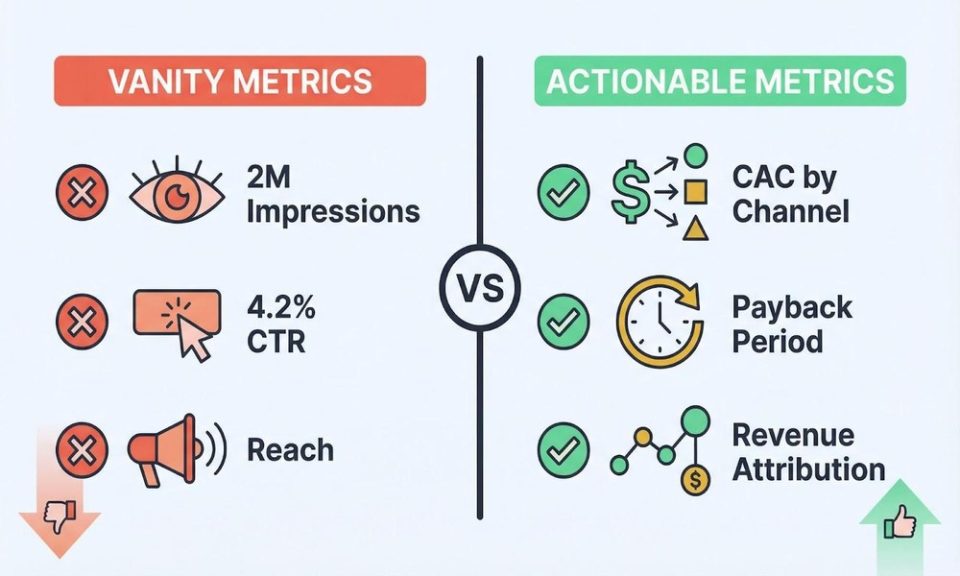
Your last agency sent a 40-page report full of impressions, reach, and click-through rates. None of those numbers appeared in your board deck. You still couldn’t answer the one question that matters: is marketing making us money?
Here’s how to evaluate a growth partner using metrics that actually drive decisions.
Why Most Agency Reporting Is Useless
Agencies default to platform metrics because they’re easy to pull. Facebook says you got 2 million impressions. Google says your CTR is 4.2%. Neither number tells you whether those clicks became customers.
The reporting problem runs deeper than vanity metrics. Most agencies don’t have access to your CRM, your activation data, or your revenue numbers. So they report what they can measure — which is everything except what you need to know.
Even agencies that talk about “revenue attribution” often fake it. They’ll take credit for any conversion that touched their ads, regardless of whether ten other channels contributed. Without proper multi-touch modeling, you’re flying blind.
If your marketing partner can’t show you a direct line from spend to revenue, their reports are just expensive PDFs.
What Accountable Growth Reporting Looks Like
Shared Dashboards with Live Data
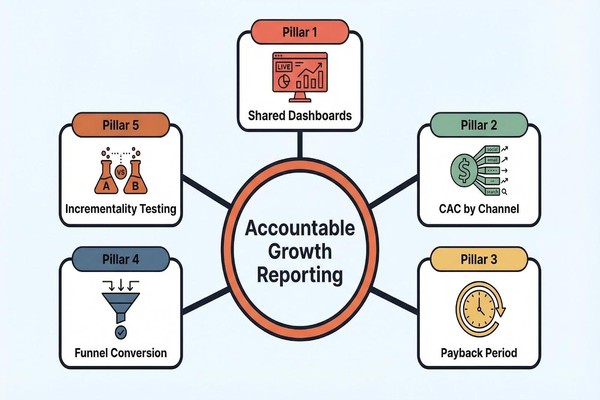
Static monthly reports are a red flag. You should have access to the same data your agency sees, updated daily. Automated dashboards eliminate the lag between spending money and knowing if it worked. A growth agency that builds real-time reporting into the engagement isn’t hiding behind presentation decks.
CAC Broken Down by Channel and Cohort
Blended CAC hides problems. Your Google Ads CAC might be $90 while your Facebook CAC is $240. Without channel-level granularity, you’ll keep funding the wrong mix. Go further — break it by monthly cohort to spot trends before they become crises.
Payback Period, Not Just LTV
LTV is a trailing indicator. It tells you what happened over years. Payback period tells you how fast you recover your acquisition cost. For startups burning cash, this is the metric that determines whether you survive long enough to see that LTV materialize.
Conversion Rate by Funnel Stage
Top-of-funnel volume means nothing if your activation rate is 3%. Demand reporting at every stage: click to lead, lead to signup, signup to activation, activation to paying customer. The drop-off point tells you where to focus.
Incrementality Testing
Your partner should regularly test whether their campaigns are causing conversions or just capturing organic demand. Holdout tests, geo-lift analysis, or matched market experiments reveal true incremental impact. If they’ve never run one, they don’t know if they’re actually working.
How to Hold Your Growth Partner Accountable
Agree on three to five KPIs before the engagement starts. Write them into the contract. CAC target, conversion rate improvement, pipeline contribution, and payback period are good starting points. If the agency pushes back on committing to outcomes, that tells you everything.
Require weekly async updates tied to those KPIs. A short Loom or written summary every week that answers: what did we spend, what did we get, what are we changing? This cadence catches problems in days instead of months.
Insist on CRM and analytics integration from week one. Your partner needs access to your revenue data. If they can’t connect their work to your bottom line, their reporting will always be incomplete. The best partners use attribution modeling across every touchpoint — from first click to closed deal. A data-driven growth agency will push for this integration, not resist it.
Run a quarterly business review with your leadership team. Monthly check-ins handle tactics. Quarterly reviews should cover strategic impact: are we hitting growth targets? Is CAC trending down? What should we invest more in? Make your agency present to the same audience that sees your board metrics.
Benchmark against your own historical data. External benchmarks are noisy. Compare this quarter to last quarter. Compare this agency’s first 90 days to the previous approach. Improvement relative to your baseline is the most honest measure.
The Cost of Measuring the Wrong Things
Startups that report on vanity metrics make worse decisions. They overfund channels that look good on paper. They kill campaigns that are actually working. They lose quarters before realizing the numbers were misleading.
The startups scaling fastest right now have dashboards their CFO can read. They know their CAC by channel today, not 30 days from now. They’ve cut acquisition costs by up to 37% because they can see exactly where money is wasted.
Every month you operate without clear attribution is a month you’re making allocation decisions on gut feeling. Your competitors aren’t guessing. They have the data, and they’re using it to take your market share while you’re still waiting for last month’s report.
Demand better numbers. The ones you measure are the ones you’ll improve.
