
Introduction: The Hidden Cost of Development Decisions
In today’s fast-moving digital economy, enterprises are under constant pressure to deliver applications faster, smarter, and more cost-effectively. Yet, one critical decision continues to shape long-term success — choosing between traditional development and low-code platforms.
While traditional development may seem familiar, it often comes with hidden costs that compound over time. On the other hand, partnering with a modern low code company like We LowCode is helping enterprises rethink how they build, scale, and optimize applications.
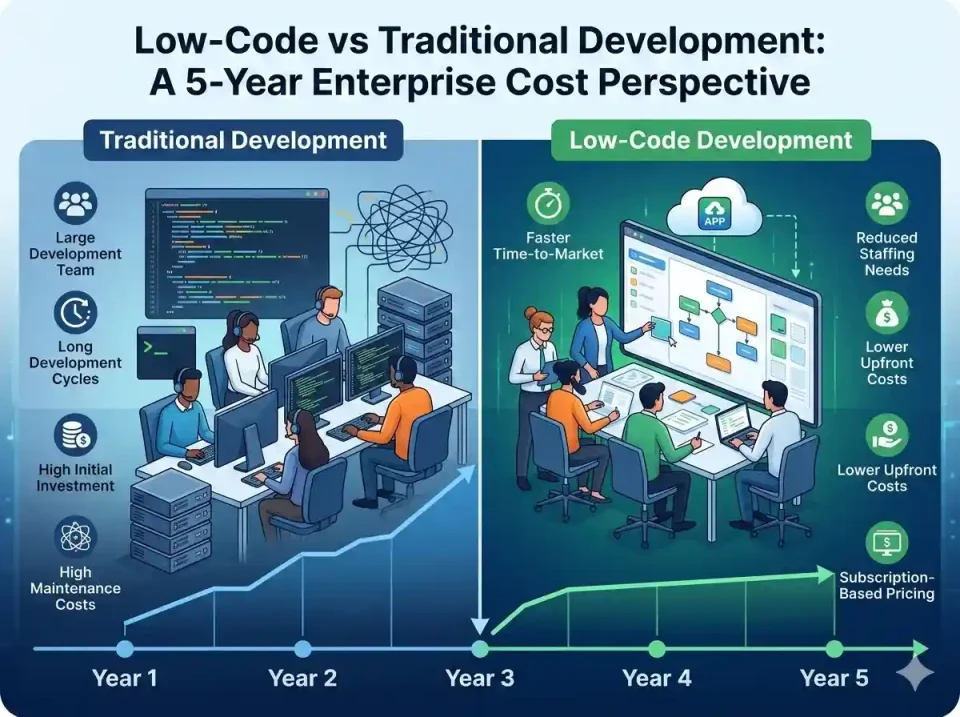
This blog explores a detailed 5-year cost perspective, helping decision-makers understand where real value lies.
Understanding the Two Approaches
Traditional Development
Traditional development involves:
- Custom coding from scratch
- Large development teams
- Longer development cycles
- Continuous maintenance overhead
While it offers flexibility, it demands significant time, cost, and resources.
Low-Code Development
Low-code platforms, supported by expert mendix consulting, enable:
- Rapid application development
- Visual modeling and reusable components
- Reduced dependency on large coding teams
- Faster deployment cycles
Companies like We LowCode leverage platforms like Mendix to deliver scalable enterprise-grade applications efficiently.
5-Year Cost Breakdown: Low-Code vs Traditional Development
1. Initial Development Cost
Traditional Development:
- High upfront investment
- Requires large teams (developers, testers, architects)
- Longer timelines = increased cost
Low-Code Approach:
- Reduced team size
- Faster build cycles
- Lower initial investment
👉 Over 5 years, low-code reduces upfront costs by 30–50%
2. Time-to-Market Impact
Traditional:
- 6–12 months development cycle
- Delayed business outcomes
Low-Code:
- 2–4x faster delivery
- Rapid prototyping and iteration
👉 Faster launch = faster ROI generation
3. Maintenance & Upgrades
Traditional Development:
- Ongoing bug fixes and updates
- High dependency on developers
- Expensive version upgrades
Low-Code Platforms:
- Automated updates
- Simplified maintenance
- Built-in scalability
👉 Maintenance costs drop significantly over time
4. Talent & Resource Costs
Traditional:
- Hiring specialized developers
- High salaries and retention challenges
Low-Code:
- Smaller teams
- Less dependency on niche skills
- Easier onboarding
👉 Talent costs reduce by 40–60% over 5 years
5. Scalability & Future Readiness
Traditional Development:
- Requires re-architecture for scaling
- Expensive system upgrades
Low-Code with AI Integration:
- Built for scalability
- Easy integration with ai app development services
- Future-ready architecture
👉 Low-code ensures long-term adaptability
Why Enterprises Are Moving Toward Low-Code
Forward-thinking organizations are increasingly choosing low-code because it delivers:
- Faster digital transformation
- Reduced operational costs
- Greater business agility
- Seamless AI integration
- Scalable enterprise solutions
With expert mendix consulting, businesses can unlock the full potential of low-code platforms without compromising on performance or flexibility.
How We LowCode Delivers Cost-Efficient Solutions
At We LowCode, we help enterprises transition from expensive traditional systems to efficient, scalable low-code ecosystems.
Our expertise includes:
- End-to-end low-code application development
- Advanced Mendix implementation
- Integration with ai app development services
- Scalable SaaS and enterprise solutions
As a trusted low code company, we focus on delivering measurable ROI, faster deployment, and long-term cost savings.
Future Outlook: The Next 5 Years of Development
The future of enterprise development is being shaped by:
- Low-code + AI convergence
- Faster go-to-market expectations
- Increasing demand for scalable digital ecosystems
Organizations that continue relying solely on traditional development may face rising costs and slower innovation cycles.
Meanwhile, companies adopting low-code — with the support of partners like We LowCode — are positioning themselves for sustained growth and efficiency.
Conclusion: Making the Smart Investment
When viewed over a 5-year horizon, the difference is clear:
- Traditional development = high cost, slower ROI
- Low-code development = cost efficiency, speed, scalability
For enterprises aiming to stay competitive, adopting low-code is no longer optional — it’s strategic.
Partnering with a proven low code company like We LowCode, backed by expert mendix consulting and integrated ai app development services, ensures your business is ready for the future.
Call to Action
Ready to reduce development costs and accelerate innovation?
Partner with We LowCode today and build scalable, future-ready applications with confidence.
👉 Schedule your free consultation now
